
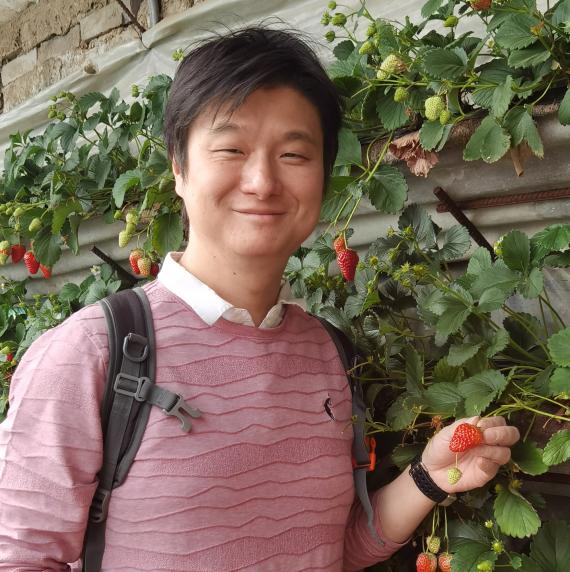
Biography
Wei Wang is an Assistant Professor in the School of Life Sciences, Center for Life Sciences at Peking University, China. He received his Ph.D. degree from Duke University and B.S. degree from Fudan University. His group aims to unravel how the precise coordination across space and time—spatiotemporal regulation—allows plants to adapt to both stochastic and periodic stresses. His group focusses on two critical layers of this regulation: the rapid, subcellular organization of responses by dynamic stress granules (SGs), and the organism-wide circadian clock system that integrates diverse stress signals. His work investigates how specific stresses are perceived and trigger SG assembly, and how various stresses are interpreted as inputs to modulate the circadian system—a concept extended by their recent discovery of a novel, stress-elicited noncanonical circadian gene regulatory network in refrigerated postharvest strawberry fruits. Understanding these complementary spatial and temporal regulatory paradigms, including the plasticity of the clock itself under complex stresses, is key to deciphering overall stress adaptation. The ultimate goal is to bridge basic discovery and agricultural application by leveraging this mechanistic understanding to engineer crops with enhanced stress resilience.