
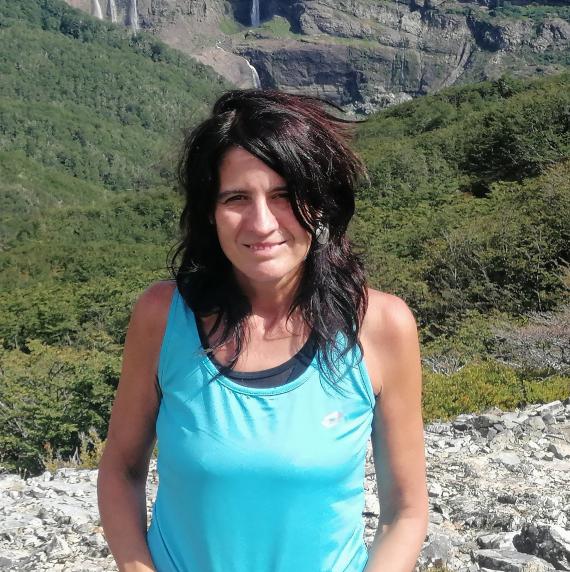
Biography
Dr. María Verónica Arana is a researcher at the Argentine National Scientific and Technical Research Council (CONICET), based at the Instituto de Investigaciones Forestales y Agropecuarias Bariloche (IFAB, INTA–CONICET), Argentina. She earned her PhD in Biological Sciences at the University of Buenos Aires under the supervision of Prof. Rodolfo Sánchez, where she investigated the interaction between light and hormonal signalling pathways in the regulation of phenology of germination and seedling development. She subsequently completed a postdoctoral fellowship at the Institute of Molecular and Cellular Biology of Plants (IBMCP, Spain), working with Dr. Miguel Blázquez and Dr. David Alabadí on the circadian regulation of gibberellin signalling in Arabidopsis thaliana. Currently, her research focuses on understanding how non-model plant species perceive and respond to environmental cues through integrative field and laboratory approaches. Using Patagonian trees of the genus Nothofagus, she is particularly interested in how temperature affects circadian clock function and how this relates to the thermal plasticity of seedlings in natural environments.

Seed dormancy responses to temperature relate toNothofagusspecies distribution and determine temporal patterns of germination across altitudes in Patagonia
María V. Arana, et. al.
Genomic responses to climate: Understanding local adaptation in the Andean tree species Nothofagus pumilio and implications for a changing world
Jill Sekely, et. al.
Effect of temperature on circadian clock functioning of trees in the context of global warming
Maximiliano Estravis‐Barcala, et. al.