Biography
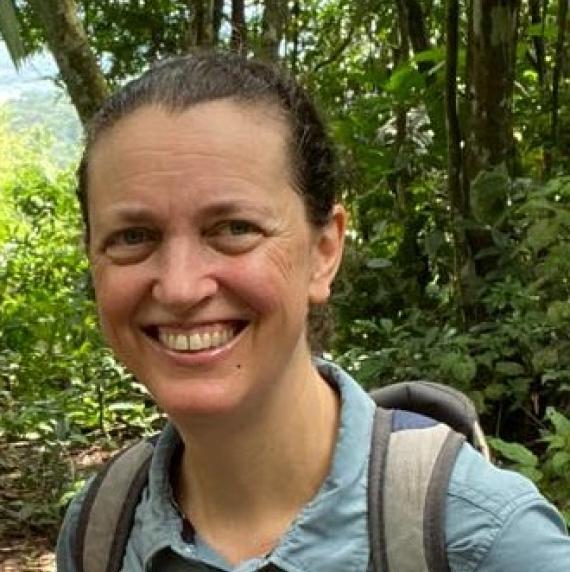
Dr. Helene Muller-Landau is a senior scientist at the Smithsonian Tropical Research Institute. Her research integrates empirical and theoretical approaches to investigate the diversity, structure and dynamics of plant communities and terrestrial ecosystems, especially of tropical forests. One major theme concerns the forces maintaining tropical woody plant species diversity and shaping the functional composition and diversity of tropical trees and lianas. Another concerns quantifying the carbon budgets of tropical forests, investigating how these respond to environmental variation and depend on plant functional composition, and improving the representation of tropical forests in Earth System Models.
Helene obtained a BA in Mathematics and Statistics from Swarthmore College, and an MA and PhD in Ecology and Evolutionary Biology from Princeton University. Before joining STRI, she did postdoctoral work at Princeton and at the National Center for Ecological Analysis and Synthesis, and was an assistant professor in Ecology, Evolution and Behavior at the University of Minnesota. She has twice won the Smithsonian Secretary’s Research Prize, most recently for the edited book “The First 100 Years of Research on Barro Colorado Island: Plant and Ecosystem Science.” She was elected to the American Academy of Arts and Sciences in 2024.
Patterns and mechanisms of spatial variation in tropical forest productivity, woody residence time, and biomass
Helene C. Muller‐Landau, et. al.
How some tropical trees benefit from being struck by lightning: evidence for Dipteryx oleifera and other large‐statured trees
Evan M. Gora, et. al.
Simulating environmentally‐sensitive tree recruitment in vegetation demographic models
Adam R. Hanbury‐Brown, Thomas L. Powell, Helene C. Muller‐Landau, S. Joseph Wright, Lara M. Kueppers